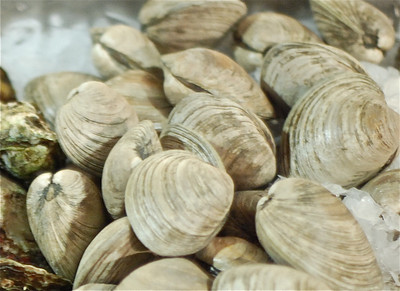
FRESH CLAMS ON ICE
I spent much of this week on the West Coast, soaking up the sunshine and tasting the local specialties. For shellfish fans West Coast dining can be bliss. Home to petite Olympia oysters and gargantuan geoduck clams, it’s the perfect place for these delicacies.
Among the bivalves – scallops, mussels, oysters and clams – I’m partial to clams. Sentimentality influences this for they were the first bivalves that I’d ever tasted. Dipped in batter, fried until crisp and golden and paired ketchup, they were the most exotic thing that eight-year-old me had ever eaten.
Only two varieties of clams exist – hard-shell and soft-shell. Possessing a grayish shell less than two inches in diameter, the East Coast littleneck is the smallest hard-shell. Registering at two and a half-inches, the cherrystone comes next followed by the quahog or chowder clam. The quahog measures between three to six inches. Hard-shells such as Pacific littlenecks, Manilas, pismos and butter all hail from the West Coast.
Contrary to their name, soft-shells possess slender, brittle shells that don’t close completely. All soft-shells possess long siphons or “necks” that stick out of their shells. These necks prohibit closure. Soft-shells include such favorites as steamers and razors. They also have the monstrously large geoduck in their family. Pronounced “gooey duck,” the geoduck’s neck can jut out several feet. If you watch the Discovery Channel’s “Dirty Jobs“, you may remember Mike Rowe’s day at a geoduck hatchery.
With clams size matters. The smaller the clam, the tenderer the texture. Large clams, such as quahogs, usually end up chopped or minced and added to chowders or fritters. Small ones tend to be steamed. All should be cooked gently so that they don’t become tough and chewy. For me there are few things less appealing than having to gnaw away on rubbery food.
On nights when I crave these bivalves but don’t have the luxury of eating out, I buy a few dozen live clams at my local grocery store. If I’m not cooking them immediately, I place them, uncovered, in an ice-filled bowl in my refrigerator. They’ll keep for up to two days.
When I don’t feel like fiddling around with shells, I opt for canned or shucked clams. These are best used in recipes calling for chopped, minced or ground clams such as in fritters and sauces. Dishes such as West Coast Manila clams steamed in an herb-garlic broth will require fresh, whole clams.
MANILA CLAMS IN HERB-GARLIC BROTH
Serves 4 as an appetizer
This appetizer couldn’t be simpler to make. Just scrub the shells, boil the wine, steam the clams, add butter and eat. As with all bivalves, if the shell doesn’t open after steaming, discard it.
2 tablespoons olive oil
5 cloves garlic, grated
1 1/2 cup dry white wine
¾ cup clam juice
¼ cup fresh flat leaf parsley, washed and minced
1 teaspoon dried oregano
3 ½ dozen Manila or other small hard-shelled clams, scrubbed
6 tablespoons unsalted butter, at room temperature
ground white pepper, to taste
baguette or crusty white bread, sliced
Heat the oil in a medium-sized stockpot. Add the garlic and sauté until softened but not browned. Add the white wine, parsley and oregano and bring to a boil. Tumble in the clams, cover the pot with a lid and allow the clams to steam until opened, about 5 to 10 minutes. Spoon in the butter and ground white pepper and allow to simmer for another 2 to 3 minutes. Serve with slices of crusty white bread or baguette for dunking into the sauce.